02 Paintings, The Art Of The Nude, Paul Sieffert's A MOMENT OF REPOSE and RECLINING NUDE, with footnotes # 172

Paul Sieffert, French, 1874 - 1974
A MOMENT OF REPOSE
Oil on canvas
60 by 100 cm., 23½ by 39¼ in.
Private collection

Paul Sieffert, born in Paris on November 11, 1874 and died in 1957, was a French painter of nudes and portraits, and also an illustrator. He  belonged to the French School.

Paul Sieffert was a student of Jean-Léon Gérôme , Gabriel Guay and Albert Maignan . He exhibited at the Salon since 1894, and at the Society of Friends of the Arts in Bordeaux from 1910 to 1939. He received the First Grand Prix ​​at Rome in 1902, the diploma of honor at the Exhibition of 1937. He was secretary of competition at French artists and member of the committee and jury. Knight of the Legion of Honor , in 1931. Member of the Committee of the Free Society of French Artists . He also exhibited at the Salon d'Hiver from 1910 to 1944.

He was also known for his stained glass, decorative compositions and illustrations of luxury books and collections of poetry, including The Flanks of the Vase, followed by Polyphemus and Unfinished Poems (1902) by Albert Samain .

His career mostly based on his inexhaustible production of nudes. More on Paul Sieffert
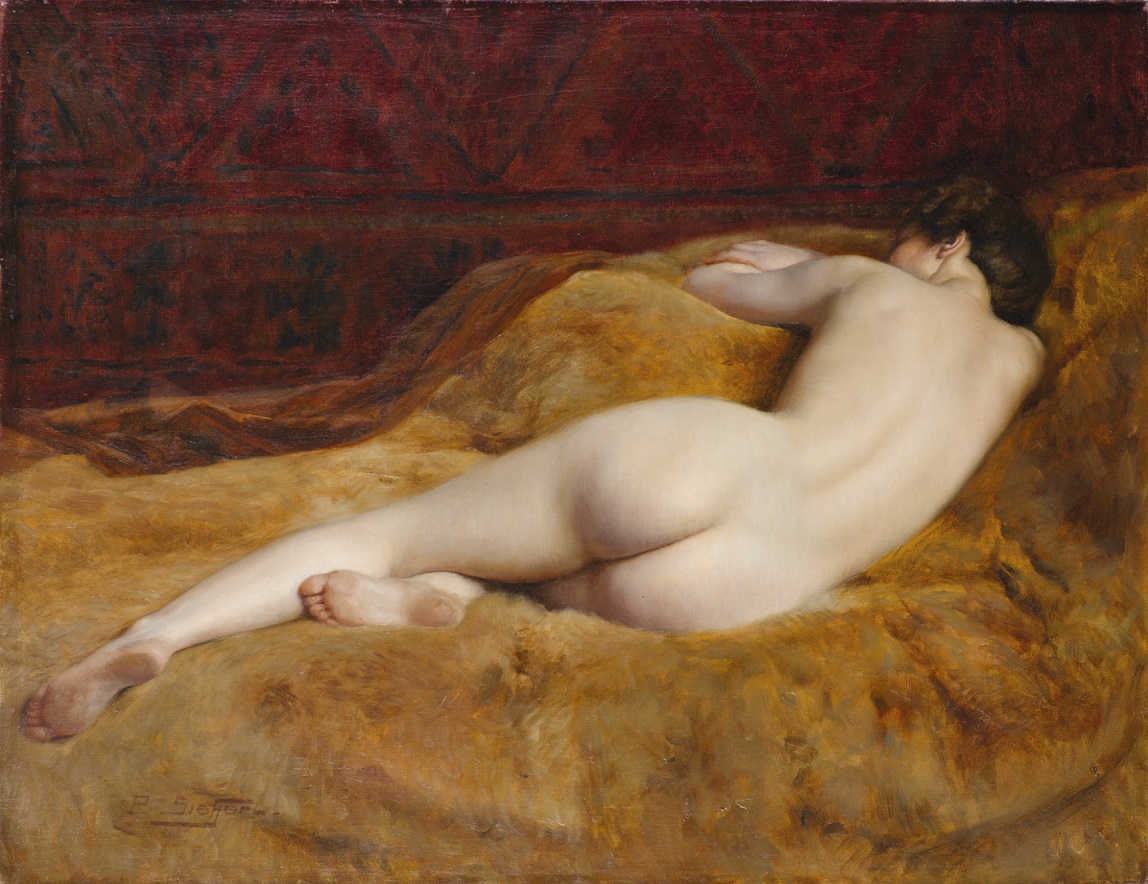
Paul Sieffert, French, 1874 - 1974
NU ALLONGÉ/ RECLINING NUDE
Oil on canvas
50 by 65 cm, 20 by 25¾ in
Private collection


Please visit my other blogs: Art Collector, Mythology, Marine Art, Portrait of a Lady, The Orientalist, Art of the Nude and The Canals of Venice, Middle East Artists, 365 Saints and 365 Days, also visit my Boards on Pinterest

Images are copyright of their respective owners, assignees or others. Some Images may be subject to copyright

I don't own any of these images - credit is always given when due unless it is unknown to me. if I post your images without your permission, please tell me.

I do not sell art, art prints, framed posters or reproductions. Ads are shown only to compensate the hosting expenses.

If you enjoyed this post, please share with friends and family.

Thank you for visiting my blog and also for liking its posts and pages.

Please note that the content of this post primarily consists of articles available from Wikipedia or other free sources online.


05 Paintings, The Art Of The Nude, Hilo Chen's sunbathing on beaches or lounging in the Bath, with footnotes # 174

Hilo Chen
Beach 26, c. 1974
oil on canvas
48 x 68 in
Private collection

Sold for $4,000 USD in October 2017

Hilo Chen (American, b. 1942)
Beach 111, c. 1988
Oil on canvas
38 x 52 in.
Private collection

Sold for $8,750.00 in May 2015

A first-generation photorealist, Hilo Chen is best known for his Pop art-reminiscent paintings of female figures sunbathing on beaches or lounging by pools. His highly sexualized figures often appear topless or nude and in close-up views, with the texture of their skin rendered in meticulous detail. Despite his focus on the female body, Chen says of his paintings: “Color and space. That is what they are about. I work for every detail in the space and want to show the depth of the scene.” More on Hilo Chen

Hilo Chen
BATH ROOM - 28
Oil on canvas
152 x 152 cm. (59.8 x 59.8 in.)
Private collection

Hilo Chen (American, born 1942)
Bath Room 13 , #1977
Oil on canvas
Size:137.2 x 137.2 cm. (54 x 54 in.)
Private collection

Hilo Chen, b. 1942
BATH ROOM 16, c. 1978
Oil on canvas
137.2 x 203.2 cm. 54 x 80 in.
Private collection

Sold for €20,000 EUR in Dec 2020

Hilo Chen (born October 15, 1942 in Yilan, Taiwan) is a Taiwanese-born American painter. He is best known for his photorealistic paintings of the female figure. He is represented by Bernarducci Meisel Gallery in New York where he currently lives and works. His work is in major museum collections throughout the world including the Solomon R. Guggenheim Museum and the Taipei Fine Arts Museum. More on Hilo Chen


Please visit my other blogs: Art Collector, Mythology, Marine Art, Portrait of a Lady, The Orientalist, Art of the Nude and The Canals of Venice, Middle East Artists, 365 Saints, 365 Days, and Biblical Icons, also visit my Boards on Pinterest

Images are copyright of their respective owners, assignees or others. Some Images may be subject to copyright

I don't own any of these images - credit is always given when due unless it is unknown to me. if I post your images without your permission, please tell me.

I do not sell art, art prints, framed posters or reproductions. Ads are shown only to compensate the hosting expenses.

If you enjoyed this post, please share with friends and family.

Thank you for visiting my blog and also for liking its posts and pages.

Please note that the content of this post primarily consists of articles available from Wikipedia or other free sources online.

02 Photographs, The Art Of The Nude, BRUCE WEBER's LISA MARIE, PALM BEACH, with footnotes # 173

BRUCE WEBER, b.1946
Detail; Woman Beach Surf, Circa 1999
Gelatin silver print
10.75 x 8.75
Private collection

BRUCE WEBER, b.1946
Woman Beach Surf, Circa 1999
Gelatin silver print
10.75 x 8.75
Private collection

BRUCE WEBER, b.1946
LISA MARIE, PALM BEACH, c. 1986
Gelatin silver print
38.6 x 48.9 cm (15 1/4 x 19 1/4 in.)
Private collection

Bruce Weber (born March 29, 1946) is an American fashion photographer and occasional filmmaker. He is most widely known for his ad campaigns for Calvin Klein, Ralph Lauren, Pirelli, Abercrombie & Fitch, Revlon, and Gianni Versace, as well as his work for Vogue, GQ, Vanity Fair, Elle, Life, Interview, and Rolling Stone magazines.

His fashion photography first appeared in the late 1970s in GQ magazine, where he had frequent cover photos. He came to the attention of the general public[citation needed] in the late 1980s and early 1990s with his advertising images for Calvin Klein, and his portrait of the then young actor Richard Gere.

Weber's photographs are occasionally in color; however, most are in black and white or toned shades. They are gathered in limited edition books. More on Bruce Weber


Please visit my other blogs: Art Collector, Mythology, Marine Art, Portrait of a Lady, The Orientalist, Art of the Nude and The Canals of Venice, Middle East Artists, 365 Saints and 365 Days, also visit my Boards on Pinterest

Images are copyright of their respective owners, assignees or others. Some Images may be subject to copyright

I don't own any of these images - credit is always given when due unless it is unknown to me. if I post your images without your permission, please tell me.

I do not sell art, art prints, framed posters or reproductions. Ads are shown only to compensate the hosting expenses.

If you enjoyed this post, please share with friends and family.

Thank you for visiting my blog and also for liking its posts and pages.

Please note that the content of this post primarily consists of articles available from Wikipedia or other free sources online.


01 Painting, The Art Of The Nude, Renato Guttuso's Nudo, with footnotes # 171

Renato Guttuso, (Bagheria 1911-Roma 1987)
Nudo , c. 1957
Oil on canvas
cm 71x114
Private collection

Renato Guttuso (26 December 1912 – 18 January 1987) was an Italian painter. His best-known works include Flight from Etna (1938–39), Crucifixion (1941) and La Vucciria (1974). Guttuso also designed for the theatre and did illustrations for books. Those for Elizabeth David’s Italian Food (1954), introduced him to many in the English-speaking world. A fierce anti-Fascist, "he developed out of Expressionism and the harsh light of his native land to paint landscapes and social commentary."

He was born in Bagheria, near Palermo in Sicily, but from 1937 lived and worked largely in Rome. In his youth he joined the Gruppo universitario fascista, but later he became an anti-fascist and atheist. He joined the banned Italian Communist Party (PCI) in 1940 and left Rome to become an active participant in the partisan struggle from 1943. He was also an opponent to the Mafia. In 1972 Guttuso was awarded the Lenin Peace Prize. In 1976 he was elected to the Italian Senate as a PCI representative for the Sicilian constituency of Sciacca.

Guttuso became a member of an artistic movement named "Corrente". The movement stood for free and open attitudes, in opposition to the official culture, and chose a strong anti-fascist position in thematic choices through the years of the Spanish Civil War.

Mimise Dotti-Guttuso died on 6 October 1986. Guttuso was soon to follow his wife. He died in Rome of lung cancer at the age of 75 on 18 January 1987. On his deathbed, he allegedly embraced again the Christian faith with which he had been critical. However, there are doubts as to what really happened—in his last months, when he was bedridden, a circle of politicians and priests excluded his oldest friends from his villa. He donated many of his works to his hometown Bagheria, which are now housed in the museum of the Villa Cattolica. More on Renato Guttuso


Please visit my other blogs: Art Collector, Mythology, Marine Art, Portrait of a Lady, The Orientalist, Art of the Nude and The Canals of Venice, Middle East Artists, 365 Saints and 365 Days, also visit my Boards on Pinterest

Images are copyright of their respective owners, assignees or others. Some Images may be subject to copyright

I don't own any of these images - credit is always given when due unless it is unknown to me. if I post your images without your permission, please tell me.

I do not sell art, art prints, framed posters or reproductions. Ads are shown only to compensate the hosting expenses.

If you enjoyed this post, please share with friends and family.

Thank you for visiting my blog and also for liking its posts and pages.

Please note that the content of this post primarily consists of articles available from Wikipedia or other free sources online.


01 Work, The Art Of The Nude, Alphonsine de Challié's Young brunette woman with a pink veil at her toilet, with footnotes # 31

Alphonsine de Challié, French, 1858 - 1904
Young brunette woman with a pink veil at her toilet
Oil on canvas
62.5 by 81½ cm., 24½ by 32 in.
Private collection

Alphonsine de Challie worked in the studio of Charles Joshua Chaplin and was a friend of Berthe Morisot. In 1875, Berthe Morisot painted the' Woman with her toilet 'which is today preserved at the Art Institute of Chicago. Is she undressing or getting ready? The same mystery surrounds this picture of Alphonsine Challie who was probably influenced by his elder. More on this painting

Having grown up in an intellectual family that encouraged her talent for drawing, Alphonsine de Challié studied painting under Charles Chaplin, one of the first artists to open his studio to female students among whom were Mary Cassatt, Louise Abbéma and Madeleine Lemaire. De Challié befriended fellow artist Berthe Morisot and exhibited regularly at the Salon between 1878 and 1882. More on Alphonsine de Challié


Please visit my other blogs: Art Collector, Mythology, Marine Art, Portrait of a Lady, The Orientalist, Art of the Nude and The Canals of Venice, Middle East Artists, 365 Saints and 365 Days, also visit my Boards on Pinterest

Images are copyright of their respective owners, assignees or others. Some Images may be subject to copyright

I don't own any of these images - credit is always given when due unless it is unknown to me. if I post your images without your permission, please tell me.

I do not sell art, art prints, framed posters or reproductions. Ads are shown only to compensate the hosting expenses.

If you enjoyed this post, please share with friends and family.

Thank you for visiting my blog and also for liking its posts and pages.

Please note that the content of this post primarily consists of articles available from Wikipedia or other free sources online.

01 Photograph, The Art Of The Nude, Manuel Álvarez Bravo's Fruta prohibida/ Forbidden Fruit, with footnotes # 170

Manuel Álvarez Bravo (Mexican, 1902 - 2002)
Fruta prohibida [Forbidden Fruit] 1976, printed 1990s
Silver print
6 7/8x9 inches (17.5x22.9 cm.)
Private collection

Manuel Álvarez Bravo was a teenager when he first picked up a camera and began taking pictures, before he enrolled in night classes in painting at the Academia San Carlos, in 1917, or sought instruction in the darkroom of local German photographer Hugo Brehme. Initially self-taught, Álvarez Bravo’s style developed through study of foreign and local photography journals. In these pages, he first encountered the work of Edward Weston and Tina Modotti, who came to Mexico in 1923; the latter became a close colleague and supporter, introducing Álvarez Bravo to the artists of Mexico’s avant-garde, including Diego Rivera, Frida Khalo, and Rufino Tamayo, as well as encouraging him to send photographs to Weston.

In the 1930s, Álvarez Bravo met Paul Strand, traveling with him while he worked in Mexico, and Henri Cartier-Bresson. With Cartier-Bresson and Walker Evans he exhibited in a three-man show at the Julien Levy Gallery, New York, in 1935. Mexico was a cultural hub for many in the international avant-garde in these years; André Breton visited, including Álvarez Bravo in the Exposition of Surrealism he organized in 1940 in Mexico City. Although the artist never identified with Surrealism, it was a major theme in the analysis of his pictures throughout his career. Revealing the influence of his formative years following the Mexican Revolution of 1910, Álvarez Bravo would instead speak of his interest in representing the cultural heritage, peasant population, and indigenous roots of the Mexican people in the face of rapid modernization. More on Manuel Álvarez Bravo


Please visit my other blogs: Art Collector, Mythology, Marine Art, Portrait of a Lady, The Orientalist, Art of the Nude and The Canals of Venice, Middle East Artists, 365 Saints and 365 Days, also visit my Boards on Pinterest

Images are copyright of their respective owners, assignees or others. Some Images may be subject to copyright

I don't own any of these images - credit is always given when due unless it is unknown to me. if I post your images without your permission, please tell me.

I do not sell art, art prints, framed posters or reproductions. Ads are shown only to compensate the hosting expenses.

If you enjoyed this post, please share with friends and family.

Thank you for visiting my blog and also for liking its posts and pages.

Please note that the content of this post primarily consists of articles available from Wikipedia or other free sources online.


06 Photographs, The Art Of The Nude, Manuel Alvarez Bravo's La Desvendada/ The Unveiled, with footnotes # 168

Manuel Álvarez Bravo
Detail; Nude, circa 1985
Gelatin silver print
25.4 x 20.3 cm
Private collection

Manuel Álvarez Bravo
Nude, circa 1985
Gelatin silver print
25.4 x 20.3 cm
Private collection

Manuel Alvarez Bravo (Mexican, 1902–2002)
From the series, La buena fama durmiendo/ The Good Woman Sleeping
Gelatin silver print
8 x 10"
Private collection

Dr. Marín bandaging Alicia. From the exhibition 'Colección Permanente de la Casa de Cultura de Juchitá.' April-May '87 Casa de la Fotografía. This photograph is one of the variants of La buena fama durmiendo, classified as one of the iconic ones in the Manuel Álvarez Bravo archive, it was taken on the roof of the Antigua Academia de San Carlos, in Mexico City between 1938 and 1938. More on this work

I have no further description, at this time

Manuel Alvarez Bravo (Mexican, 1902–2002)
La Buena Fama Durmiendo/ The Good Woman Sleeping, c. 1939
Gelatin silver print
16 × 20 in. (40.6 × 50.8 cm)
Private collection

Manuel Alvarez Bravo (Mexican, 1902–2002)
La Buena Fama Durmiendo/ The Good Woman Sleeping, c. 1939
Gelatin silver print
16 × 20 in. (40.6 × 50.8 cm)
Private collection

I came across this Photograph with no explanation! The model and the pose are almost the same as the above pose...

Manuel Alvarez Bravo
La Desvendada/ The Unveiled, c. 1979
Gelatin silver print
8 3/4 x 6 1/8 in. (22.2 x 15.6 cm)
International Center of Photography

Manuel Álvarez Bravo was a teenager when he first picked up a camera and began taking pictures, before he enrolled in night classes in painting at the Academia San Carlos, in 1917, or sought instruction in the darkroom of local German photographer Hugo Brehme. Initially self-taught, Álvarez Bravo’s style developed through study of foreign and local photography journals. In these pages, he first encountered the work of Edward Weston and Tina Modotti, who came to Mexico in 1923; the latter became a close colleague and supporter, introducing Álvarez Bravo to the artists of Mexico’s avant-garde, including Diego Rivera, Frida Khalo, and Rufino Tamayo, as well as encouraging him to send photographs to Weston.

In the 1930s, Álvarez Bravo met Paul Strand, traveling with him while he worked in Mexico, and Henri Cartier-Bresson. With Cartier-Bresson and Walker Evans he exhibited in a three-man show at the Julien Levy Gallery, New York, in 1935. Mexico was a cultural hub for many in the international avant-garde in these years; André Breton visited, including Álvarez Bravo in the Exposition of Surrealism he organized in 1940 in Mexico City. Although the artist never identified with Surrealism, it was a major theme in the analysis of his pictures throughout his career. Revealing the influence of his formative years following the Mexican Revolution of 1910, Álvarez Bravo would instead speak of his interest in representing the cultural heritage, peasant population, and indigenous roots of the Mexican people in the face of rapid modernization. More on Manuel Álvarez Bravo


Please visit my other blogs: Art Collector, Mythology, Marine Art, Portrait of a Lady, The Orientalist, Art of the Nude and The Canals of Venice, Middle East Artists, 365 Saints and 365 Days, also visit my Boards on Pinterest

Images are copyright of their respective owners, assignees or others. Some Images may be subject to copyright

I don't own any of these images - credit is always given when due unless it is unknown to me. if I post your images without your permission, please tell me.

I do not sell art, art prints, framed posters or reproductions. Ads are shown only to compensate the hosting expenses.

If you enjoyed this post, please share with friends and family.

Thank you for visiting my blog and also for liking its posts and pages.

Please note that the content of this post primarily consists of articles available from Wikipedia or other free sources online.


A note to the readers of Zaidan Gallery

     A note to the readers of Zaidan Gallery It is with great sadness that we share the news that the author of this blog,  Henry Zaidan (19...